



Thanks to the European Space Agency and the enthusiastic and humble work of many radio amateurs, anyone can now track the ESEO satellite and check the data sent by the orbiter in beacon signals here.
On the main map, besides the projection of the orbit of the ESEO satellite, the coordinates of its actual location (LAT: geographical latitude (°), LNG: geographical longitude (°), ALT: altitude (km)) and speed in km/s (SPD) are also displayed. Moreover, the start and the end azimuth, the maximum elevation and the corresponding date and time are also shown for the next pass of ESEO over the current location of the visitor.
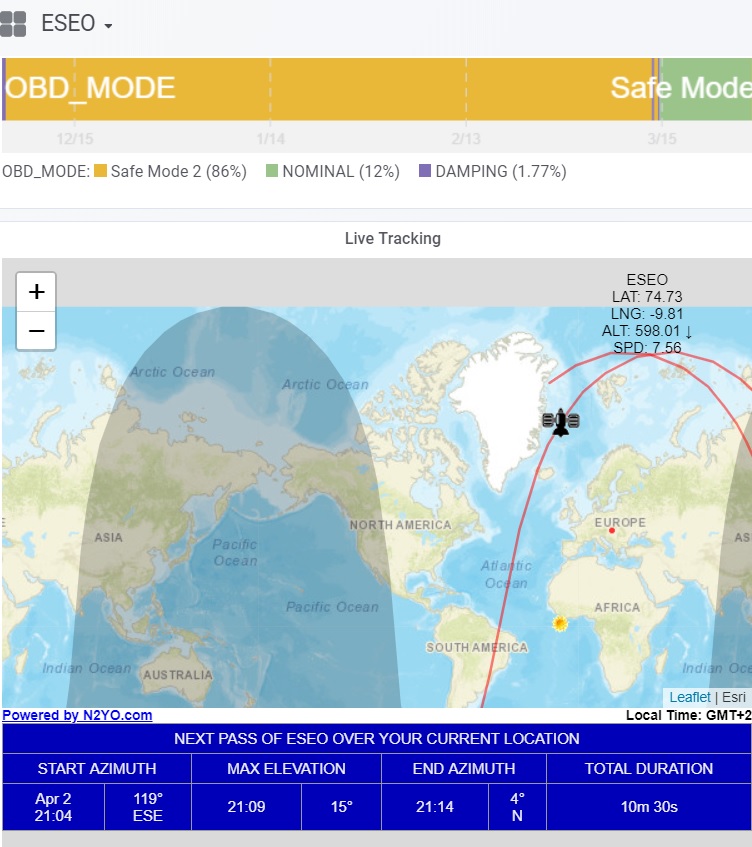
Position of the ESEO satellite and its next pass over the location of the visitor of the page eseo.ddns.net (credits: ESA).
One can select from the right menu on the website what kind of housekeeping data coming from ESEO he/she interested in. The ESEO-TRITEL instrument developed in MTA EK (and also the Langmuir probe (LMP) experiment of the students of the Budapest University of Technology and Economics) can be seen after clicking “BEACON6 - PAYLOAD”. As the ESEO-TRITEL instrument has not yet been turned on, the data shown for TRITEL may be a bit misleading for the time being as they are only default values without any physical meaning.
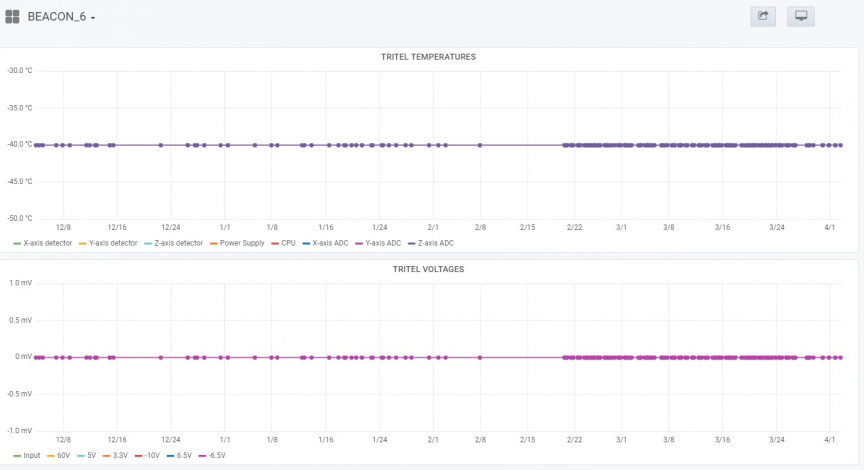 At the time of writing this post, TRITEL has not yet provided data as it is still turned off. The data points in the figure below indicate only the time of beacon signal reception; the values have no real physical meaning yet, they are only default values (credits: eseo.ddns.net , ESA).
The ESEO-TRITEL team
ESEO is an educational hand on project of the ESA Education Office, carried out as part of the ESA Academy programmes.
The activity of the University students’ teams was coordinated by SITAEL S.p.A. (Italy), System Prime and Integrator of the whole spacecraft platform.
The ESEO-TRITEL project is realized in the frame of PECS contract No. 4000112065 and the ESA PRODEX contract No. 4000124167.
For further information contact the official ESA webpage.