



The world’s largest international space congress was organized in Washington D.C this year, where our research group was also represented.
The International Astronautical Congress (IAC), organised by the International Astronautical Federation (IAF), the International Academy of Astronautics (IAA) and the International Institute of Space Law (IISL) for the 70th time in 2019, attracts more participants every year. Almost 7000 researchers, engineers, young professionals and students from all over the world participated this year’s event, organised between the 21st and the 25th of October. Besides the largest space agencies and space companies, entities dealing with public outreach and educational activities related to space research were also present in the exhibition hall of the IAC. IAC provides an excellent opportunity for the space community, besides space researchers including also representatives of space agencies, space companies and space education, to exchange ideas and experiences and to enhance one’s professional network. Besides plenaries, late breaking news and highlight lectures, presentations were given in 181 technical sessions divided into 5 main categories: Science and Exploration (A), Applications and Operations (B), Technology (C), Infrastructure (D), Space and Society (E). Interactive presentations and special sessions further enriched the programme of the conference.
Talks in the field of space radiation, its effects on human space flight and the corresponding risks were given in the A1 IAF/IAA Space Life Sciences Symposium. Attila Hirn presented the latest developments regarding the ESEO-TRITEL experiment. The first author of the talk, Balázs Zábori, had to leave for a workshop organized at by the European Space Agency (ESA) at the European Space Operations Centre (ESOC), Darmstadt, Germany with the theme “Instruments for ESA's Distributed Space weather Sensor System”. As we have reported it already, our group is recently developing a combined instrument, D3S-RadMag, for measuring space radiation and magnetic field properties for performing measurements in ESA’s small satellite constellation missions (Distributed Space weather Sensor System, D3S) to investigate and monitor space weather. Well, the life of a space researcher is rather busy but by no means boring.
There was significant Hungarian participation on the 70th IAC this year. The Hungarian Astronautical Society (MANT), member of IAF, organised the Hungarian dinner also this year for Hungarian participants of the International Astronautical Congress. The IAF also held its General Assembly during the congress. MANT was represented by MANT vice president László Bacsárdi, MANT honorary member János Solymosi and MANT secretary general Attila Hirn, head of our research group.
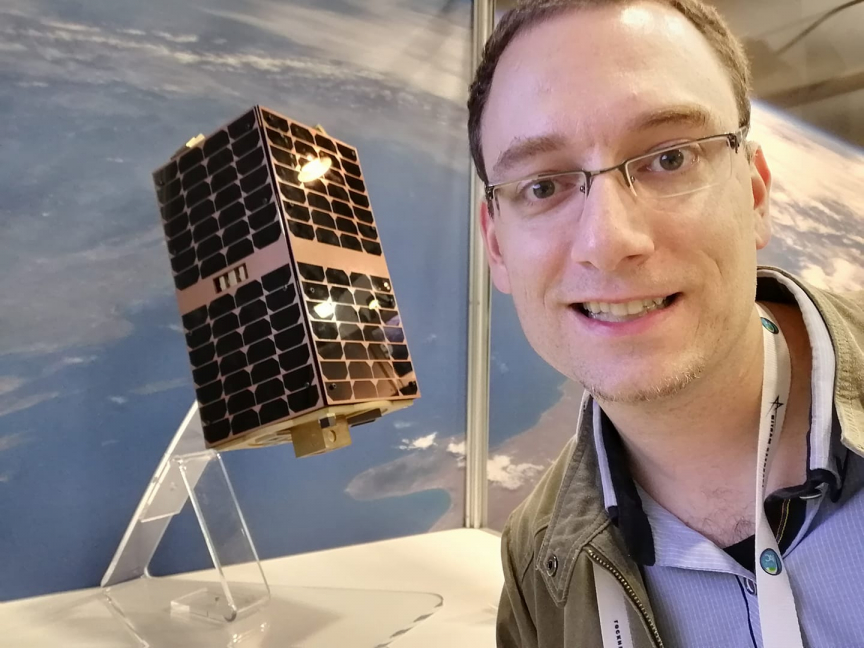
With model of the ESEO satellite at SITAEL’s booth in the exhibition hall of the IAC, in Washington D.C. The block protruding from the bottom of the satellite is our TRITEL instrument (Credits: EK)
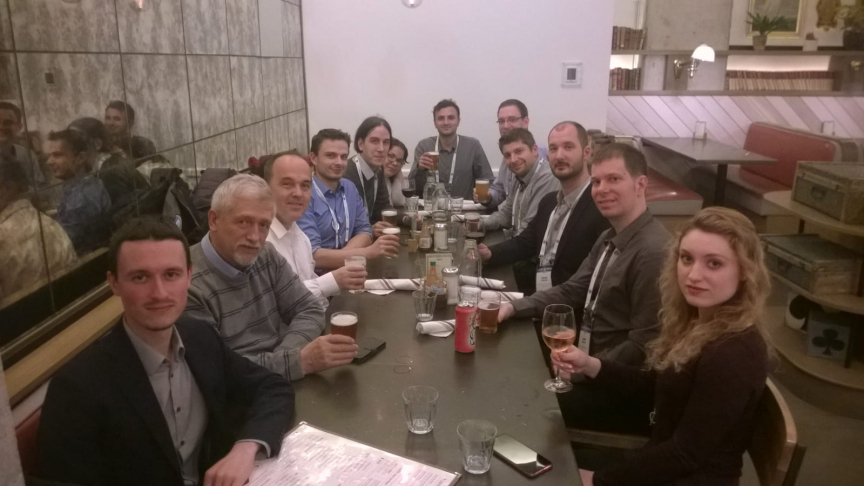
Hungarian Dinner at IAC 2019, Washington D.C. (Credits: MANT)
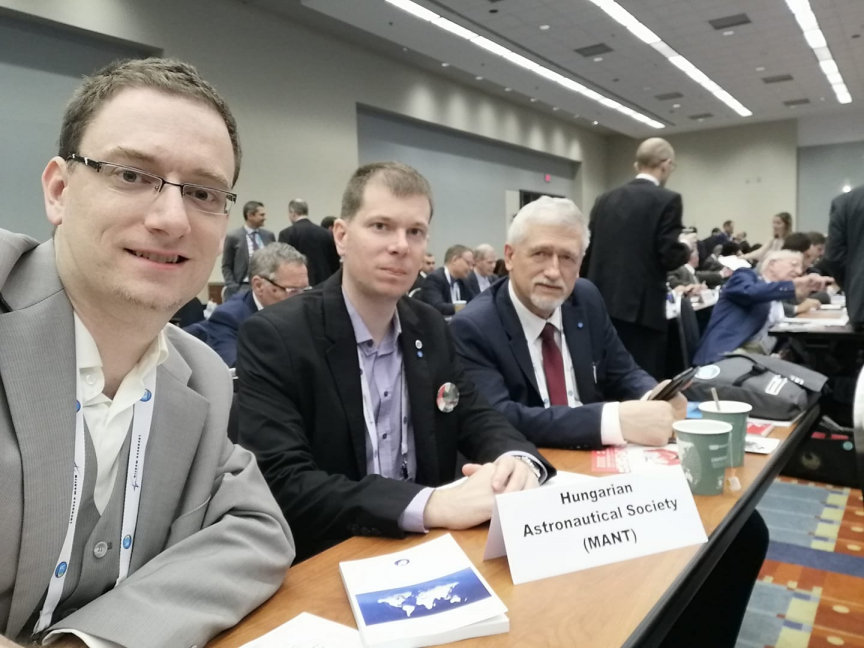
The Hungarian delegation at the IAF General Assembly (Credits: MANT)
Attila Hirn