



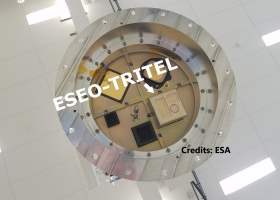
The nearly two-week-long thermo-vacuum tests of the ESEO satellite are already underway in the European Space Research and Technology Centre (ESTEC) in the Netherlands!
As we have recently reported, after the successful integration of the flight model of European Student Earth Orbiter (ESEO), the next step is the final environmental tests (thermos-vacuum, electromagnetic compatibility and functional tests) of the satellite. A modified version of the TRITEL three-dimensional silicon detector telescope, developed by the ESEO-TRITEL team with professional support from the engineers and scientists of the MTA EK Space Dosimetry Research Group, is one of the scientific payloads on board the satellite. We are looking forward to the results of the tests!
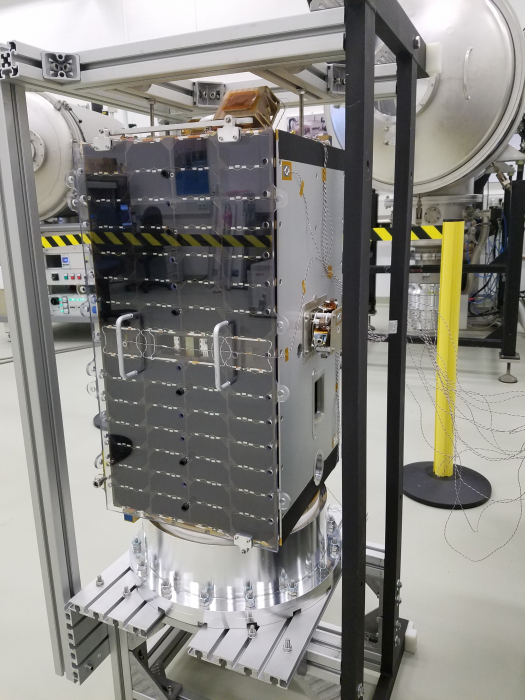 The flight model of the ESEO satellite in the test centre in Noordwijk. The face of the satellite pointing now to the ceiling will be looking into the zenith direction during the flight. The ESEO-TRITEL instrument is located on the opposite side (credits: ESA).
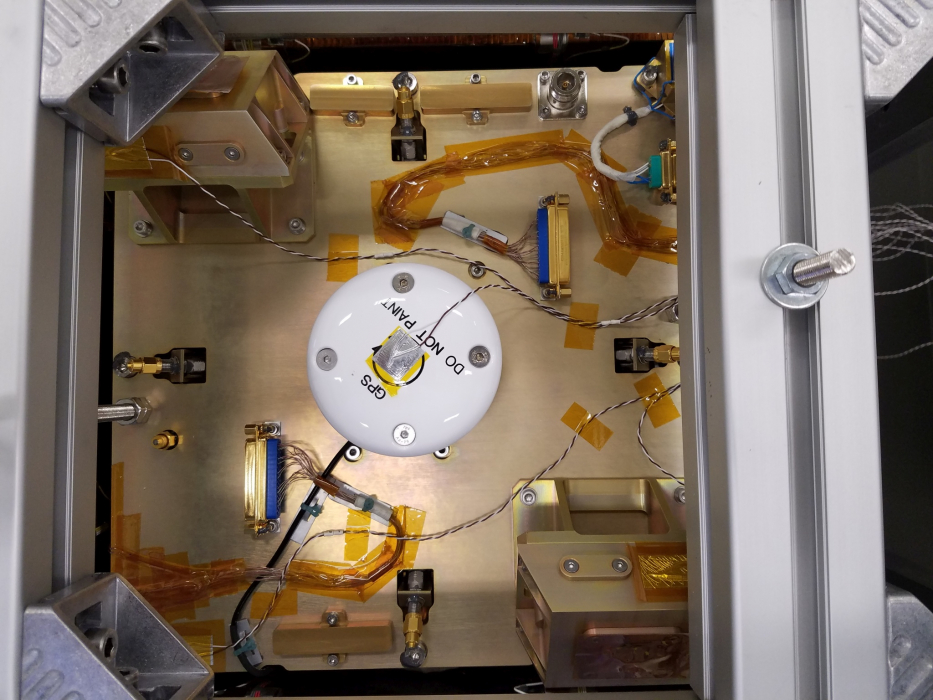
The face of the ESEO satellite pointing into the zenith direction. The GPS receiver of the satellite can be easily identified in the photo (credits: ESA).
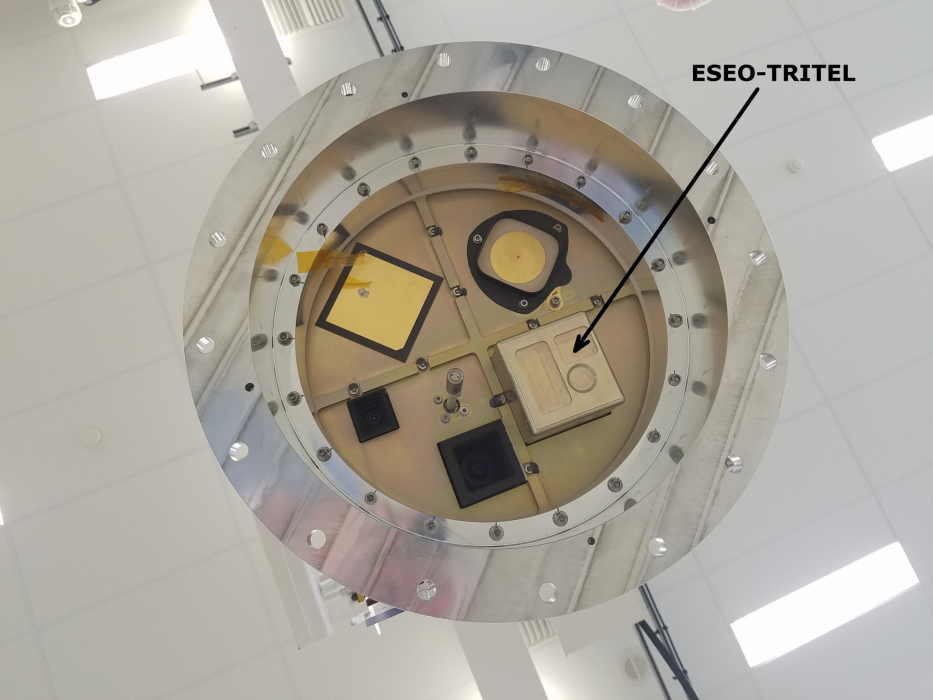
The face of the ESEO satellite pointing into the nadir direction. The section of the ESEO-TRITEL instrument containing the space radiation detectors and therefore protruding from the satellite body is indicated with an arrow in the image. The instrument was developed and manufactured with the scientific and technical support of MTA EK (credits: ESA).
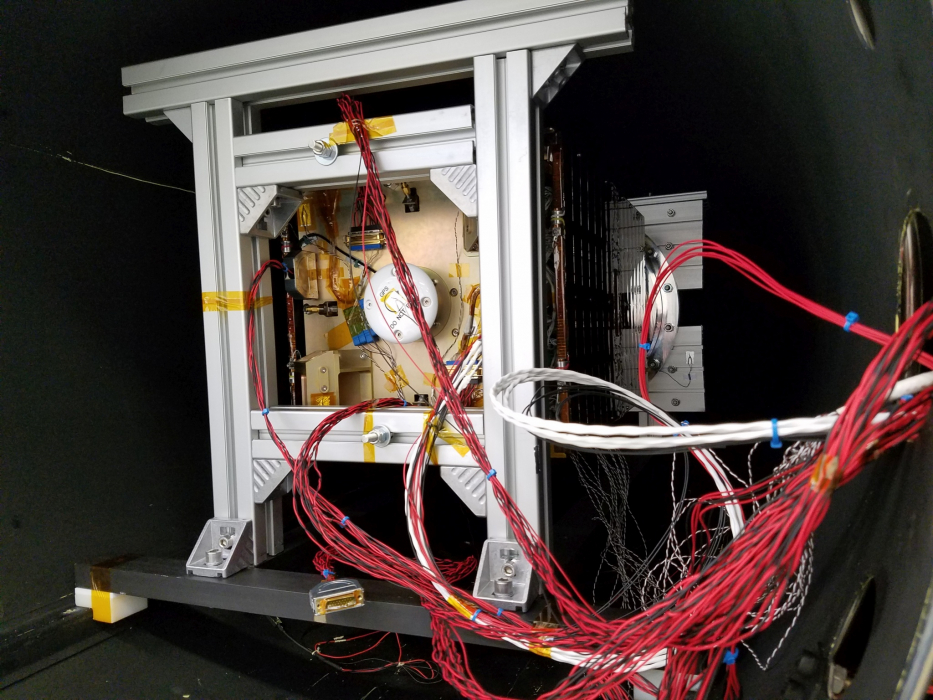
The ESEO satellite mounted into the thermo-vacuum chamber of the ESA test centre (ESTEC) in the Netherlands. The tests are still running (credits: ESA).
The ESEO-TRITEL team
ESEO is an educational hand on project of the ESA Education Office, carried out as part of the ESA Academy programmes.
The activity of the University students’ teams was coordinated by SITAEL S.p.A. (Italy), System Prime and Integrator of the whole spacecraft platform.
The ESEO-TRITEL project is realized in the frame of PECS contract No. 4000112065 and the ESA PRODEX contract No. 4000124167.