



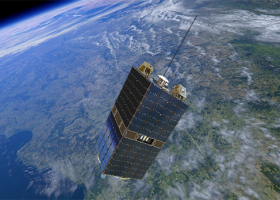
SpaceX’s SSO-A mission with Falcon 9 lifted off today at 19:34 CET from US Vandenberg Air Force Base. One of the satellites carried by the launcher is the European Student Earth Orbiter (ESEO) realized in the framework of European Space Agency (ESA) Academy’s hands-on space programme ESEO managed by the ESA Education Office, with ESEO-TRITEL on board!
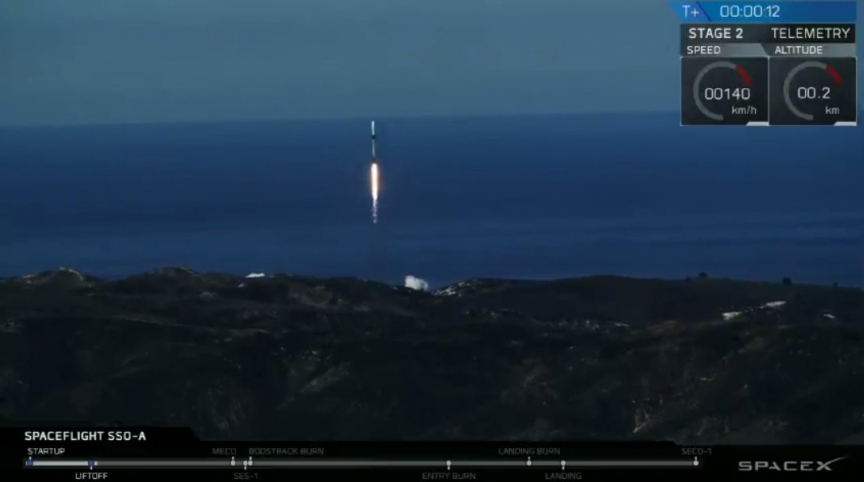
Falcon 9 lift-off with ESEO. ESEO-TRITEL is one of the scientific payloads on board (credits: ESA).
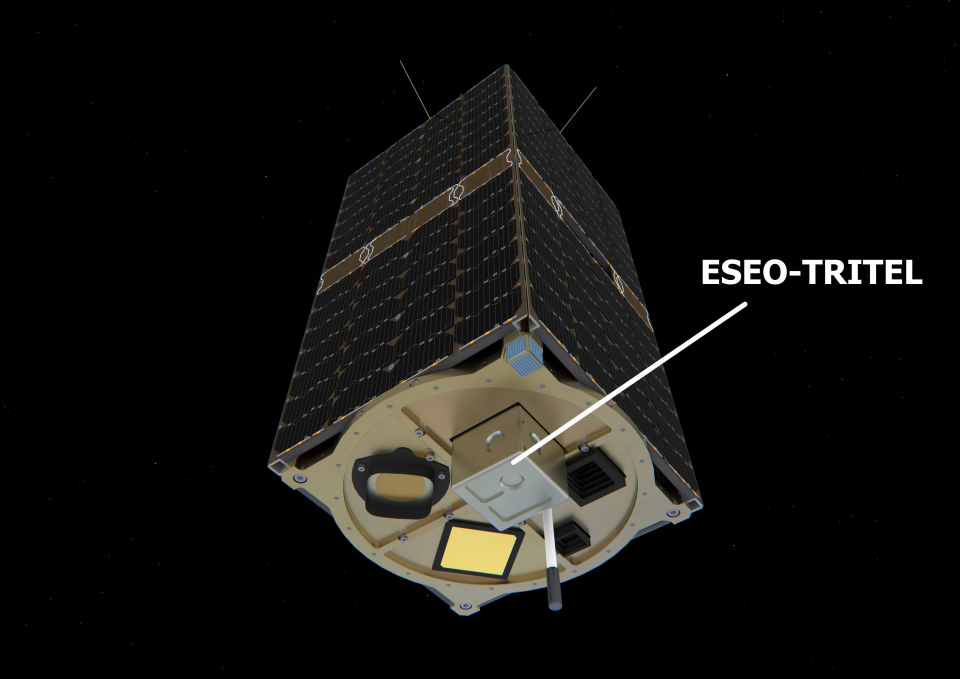
Artist impression of TRITEL on ESEO (credits: ESA).
Now ESA and the ESEO teams are waiting for confirmation from the launch authorities that the satellite has correctly separated from the launcher and it is injected into its final operational orbit. This was the first time that a Falcon 9 first stage booster has been reused for its third launch.
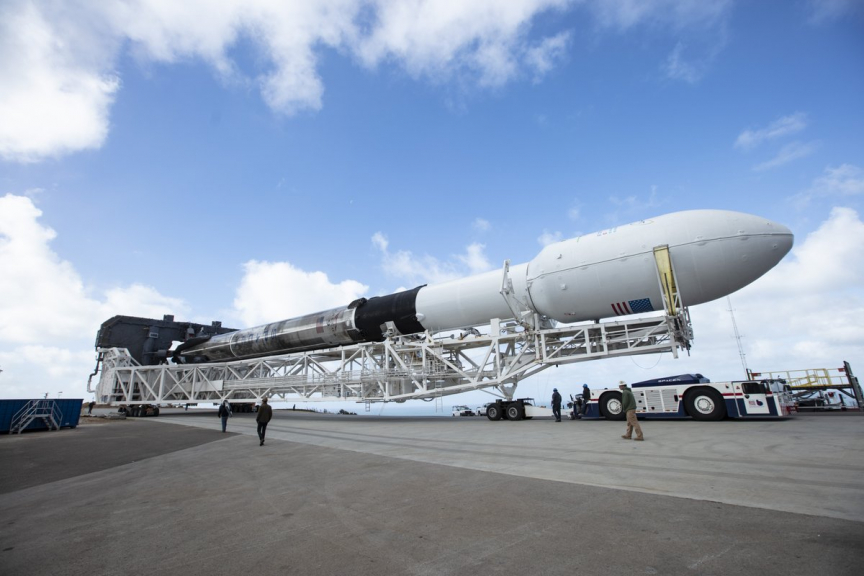
SSO-A Falcon 9 rolling out to the launch pad. The first stage to be used for the third time can be easily identified (credits: SpaceX).
Student teams from ten European universities, with over 600 students from ESA Member States have participated the ESEO programme. The students have been involved in developing all the ESEO scientific and technology demonstration payload, key sub-systems, and the entire ground segment. ESEO will operate for 6 months, with a possibility to extend its mission for another 12 months. The spacecraft will not contribute to accumulating space debris in low Earth orbit. Due to atmospheric drag, the 50-kg ESEO satellite will de-orbit in about 8-10 years.
The participation of Hungarian students in the program is significant. The ESEO Power Distribution Unit (PDU), a fundamental spacecraft subsystem designed to distribute electrical power to the whole ESEO on-board instrumentation (subsystems and payload), was developed by the ESEO-PDU team from the Budapest University of Technology and Economics. Two of the three scientific payloads were also designed by student teams from Hungary. The ESEO-TRITEL team supported by the Centre for Energy Research, Hungarian Academy of Sciences (MTA EK) developed the ESEO-TRITEL three-axis silicon detector telescope to study the radiation environment above the Earth atmosphere. It is the first of its kind to fly on a satellite mission: it is designed for continuous autonomous operations, while previous models always having been linked to manned space flights. The ESEO-LMP team developed a Langmuir Probe sensor to study the plasma (gas of charged particles) in the Earth ionosphere. The simultaneous measurements of space radiation with ESEO-TRITEL and the plasma environment with ESEO-LMP on board the European Student Earth Orbiter might provide useful scientific results!
The ESEO programme provided an excellent opportunity for university students to gain real hands-on educational experience in space engineering already during the design, development and testing phases of the satellite, of its payload, and of its ground systems and hopefully during a successful operation as well! We will report on further developments as soon as possible.
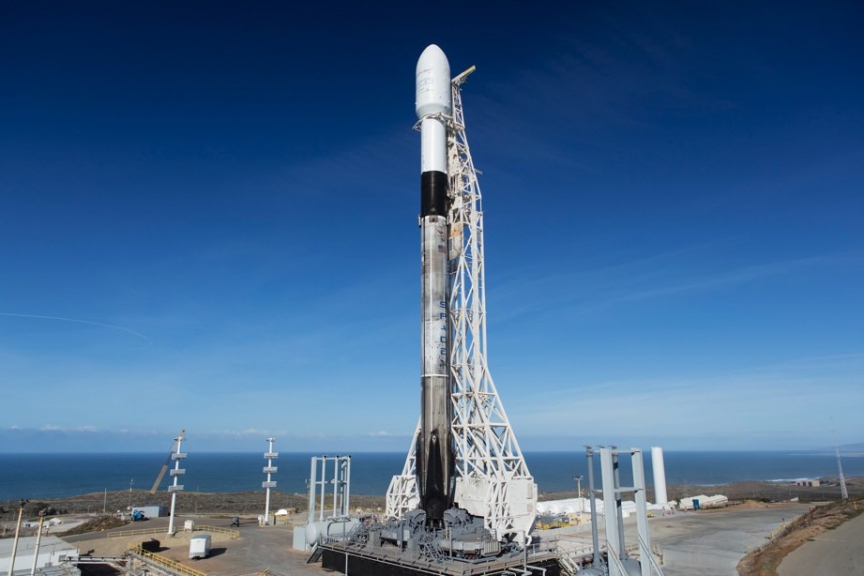
Falcon 9 SSO-A on the launch pad (credits: SpaceX).
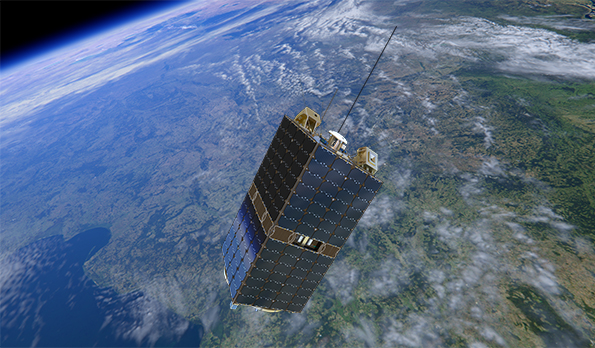 Artist impression of ESEO in orbit (credits: ESA).
The ESEO-TRITEL team
ESEO is an educational hand on project of the ESA Education Office, carried out as part of the ESA Academy programmes.
The activity of the University students’ teams was coordinated by SITAEL S.p.A. (Italy), System Prime and Integrator of the whole spacecraft platform.
The ESEO-TRITEL project is realized in the frame of PECS contract No. 4000112065 and the ESA PRODEX contract No. 4000124167.
For further information contact the official ESA webpage.