



The results of some calibration experiments using passive radiation detectors have been published recently in the scientific journal Nuclear Instruments and Methods in Physics Research, A. The main findings will be presented here.
One of the limiting factors of an astronaut’s career is the dose received from space radiation. High energy protons, being the main components of the complex radiation field present on a spacecraft, give a significant contribution to the dose. To investigate the behavior of solid state nuclear track detectors (SSNTDs) if they are irradiated by such particles, stacks of such detectors were exposed to high energy proton beams at the Proteus cyclotron, IFJ PAN – Krakow.
The incident protons cannot be detected directly; however, tracks of secondary particles, recoils and fragments of the constituent atoms of the detector material are formed. Such fragmentation events are presented in the figure below.
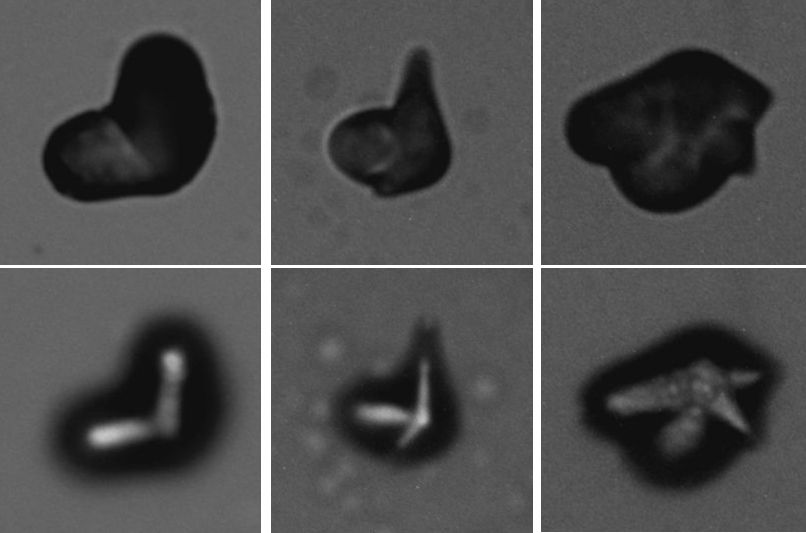
Proton induced fragmentation leading to 2, 3 and 4 visible particle tracks (from left to right). In the upper row the focus is on the surface of the detector, while in the lower row it is deeper to see the path of the particles and their common point of origin.
From the measured geometrical parameters of the tracks the dosimetric quantities were determined. The results obtained on the SSNTDs irradiated by protons were compared to those obtained on detectors flown on the Columbus module of the International Space Station (ISS) during the TRITEL-SURE experiment in 2013: they were quite similar. The differences in the quality factors (which characterize the radiation fields) were only about 5%. Thermoluminescent detectors (TLDs) were also applied in each case to measure the dose from primary protons and other particles present in space. Comparing and analyzing the results of the TLD and SSNTD measurements, it was obtained that proton induced target fragments contributed to the total absorbed dose in 3.2 % and to the dose equivalent (which assesses how much biological damage is expected from the absorbed dose) in 14.2 % during the TRITEL-SURE experiment.
Julianna Szabó
Szabó, J., Pálfalvi, J.K., Strádi, A., Bilski, P., Swakoń, J., and Stolarczyk, L., 2018. Proton induced target fragmentation studies on solid state nuclear track detectors using Carbon radiators. Nuclear Instruments and Methods in Physics Research A. 888, 196-201. https://doi.org/10.1016/j.nima.2018.01.084