



An international scientific conference, with the title "GRINGAUZ 100: PLASMAS IN THE SOLAR SYSTEM, 2018" was held in Moscow, in the Space Research Institute of the Russian Academy of Sciences (RAN IKI) between June 13 and 15, 2018 for the 100th anniversary of the birth of the world-famous plasma physicist professor and former IKI senior scientist Konstantin I. Gringauz.
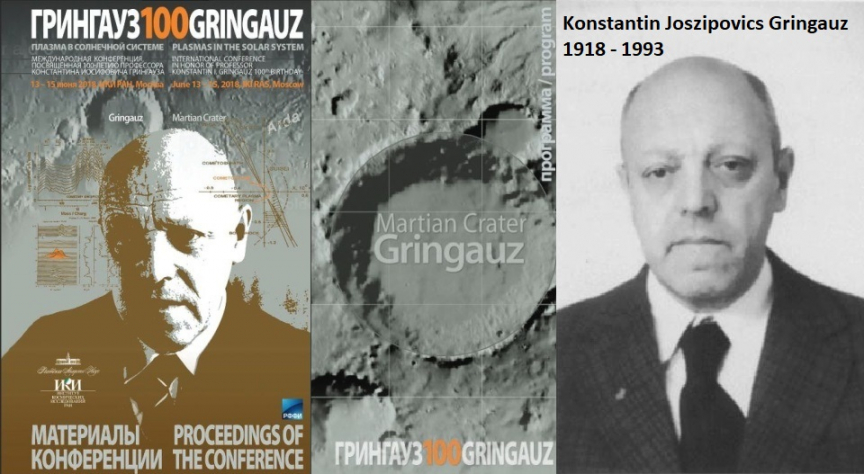
An international scientific conference was held in Moscow on the occasion of the 100th anniversary of the birth of professor Konstantin I. Gringauz (Credits: IKI/RAS)
Professor Gringauz was an iconic figure and one of the pioneers of the Soviet-Russian and the international space research. In the beginning, he dealt with the propagation of radio waves in the ionosphere. From 1947, he was working together with Sergey Korolev, lead Soviet rocket engineer and world-famous spacecraft designer. From 1948, he was involved in the pioneering ionosphere measurements performed with V-2 rockets. The shortwave radio transmitter of Sputnik-1 was designed and manufactured based on his proposal and under his management. He is well known for the very first high-altitude ionosphere measurements (Szputnik-3; 1958) and the discovery of the solar wind (Luna-1, -3) and the Earth’s plasmasphere (Luna-2, Venera-1) in 1959, for which he was awarded the Lenin Prize in 1960. He was head of laboratory in the Space Research Institute established in 1965. For the first time, he and his colleagues observed a shock wave around a planet (Venera-4, -9, -10, 1967, 1975-76) and discovered the magnetosphere of the Mars (Mars-2, -3, -5, 1971-73). He was principal investigator of the Plazmag instrument package with which the rate of neutral gas production of a comet (Comet Halley) and its density profile as well as the composition of the ion-cloud around the comet were measured for the first time in history and its ionopause was also discovered (Vega-1, -2, 1986). He also contributed to the discovery of Mars’ plasma layer (TAUS experiment, Phobos-2, 1989). As a recognition of his achievements in his life, an asteroid and one of the craters of Mars have been named after him.
The significance of his research team is indicated by the fact that the last three directors of IKI have been chosen among Gringauz’s colleagues. The main organizer of the conference was Dr. Mikhail Verigin, successor to professor Gringauz heading his laboratory for 30 years now and Dr. Galina Kotova a former colleague of him. One of the patrons of the conference was Dr Tamás Gombosi, former senior scientist of MTA KFKI Institute for Particle and Nuclear Physics (MTA KFKI RMKI), who was candidate for professor Gringauz and today, he is professor at the University of Michigan, correspondent member of the Hungarian Academy of Sciences, one of the most prominent experts in space weather research.
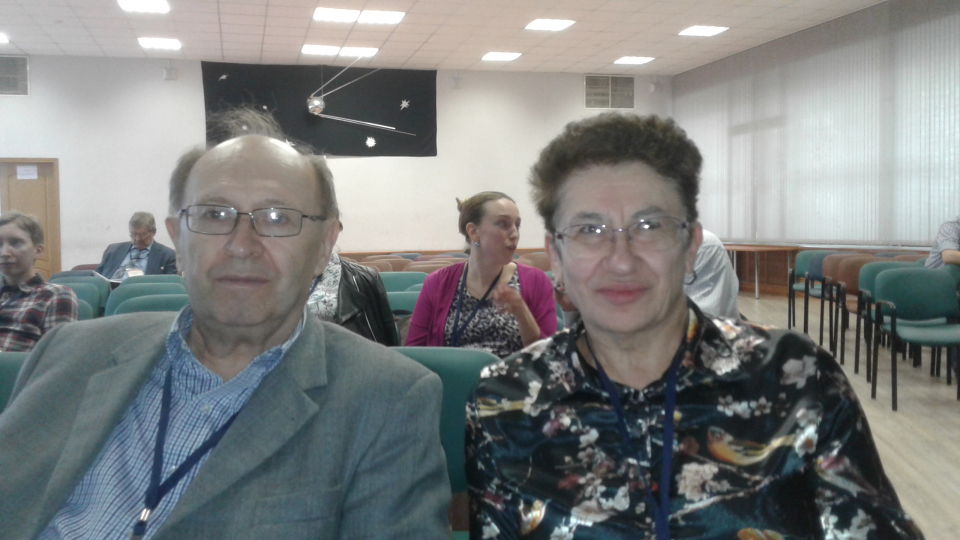 Dr. Mikhail Verigin, successor to professor Gringauz heading his laboratory for 30 years now and Dr. Galina Kotova a former colleague and main organizers of the conference
Starting from the 70’s, professor Gringauz and his research group was in close working relationship with the MTA KFKI RMKI (today: MTA Wigner Research Centre for Physics) and the MTA Geodetic and Geophysical Research Institute in Sopron (MTA GGKI, today: MTA CSFK Geodetic and Geophysical Institute). The predecessor of our research group, the Space Electronics Group, established in 1970, in collaboration with the Vernadsky Institute of Geochemistry and Analytical Chemistry (GEOKHI), Moscow, and the Astronomical Observatory, Prague, developed and manufactured electronic units for micrometeorite detectors flown on Interkosmos satellites (Interkosmos-12, -14, -17 satellites, 1974, -75, -77). The project, in lack of scientific interest in Hungary, ended in 1977.
In 1976, after a visit at IKI, a long lasting cooperation in the field of plasma research has been established, which had a significant impact on the future of our research group: a cooperation with IKI (with Gringauz and his colleagues) and GGKI (Pál Bencze and his colleagues), which was later expanded with the Graz University of Technology (as a predecessor to the Austrian Space Research Institute) and the Max Planck Institut für Aeronomie (MPAE) in Lindau. Researchers of the MTA KFKI RMKI had also important role in the evaluation and interpretation of measurement data. As a result of this cooperation and through the on-board instruments and components made by our group, the Hungarian space research became a decisive part in several space experiments of great importance. The LAM instruments measured parameters of the ionosphere on geophysical rockets (Vertikal-6, -7, -10; 1977, 1978, 1981) and the D-173B equipment the angular distribution and the energy spectrum of the solar wind on the Prognoz-7 satellite (1978). Our group designed and manufactured (in cooperation with the Technical University of Budapest) the electronics for the Plazmag charged particle spectrometers on the Vega space probes at Comet Halley (1986), and I, as a guest researcher at MPAE, developed the electronics for the TAUS mass spectrometers on board the Phobos space probes (1989). The “world’s first” measurement results obtained were published in Nature. Finally, at the turn of the millennium, the plasma detector of the ROMAP instrument and the DIM dust impact monitor (primarily developed at the MTA KFKI AEKI Measurement Automation Laboratory) were made with the participation of our research group, with which the very first measurements in the history of science were performed on the surface of a comet’s nucleus (67P/Churyumov-Gerasimenko, Rosetta / Philae, 2014). This outstanding results were published in Science.
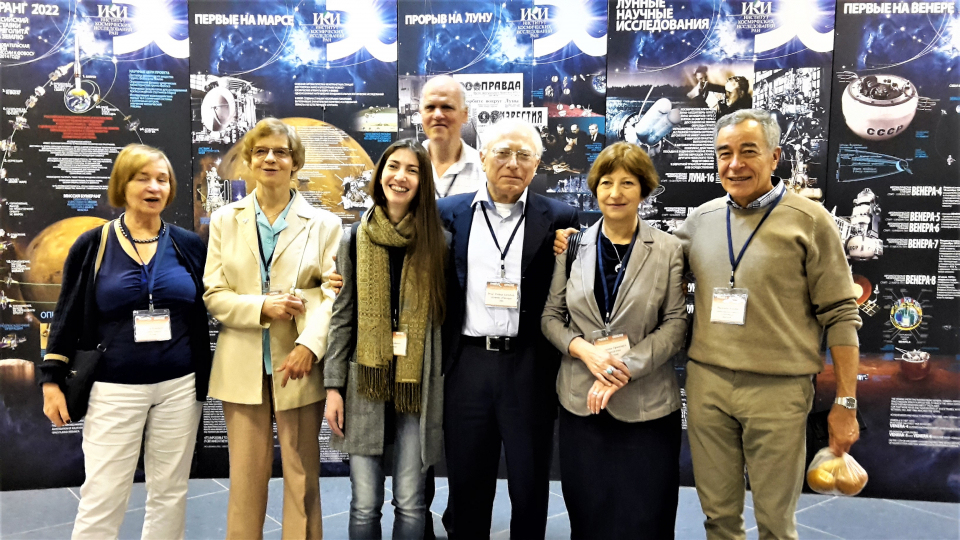
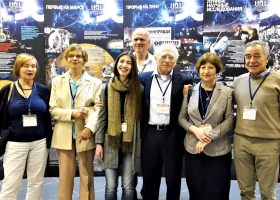
Group photo taken at the conference, from left to right: a participant of the conference, Mariella Tátrallyay (MTA Wigner FK), Gringauz’s granddaughter, Károly Kecskeméty (MTA Wigner FK) Tamás Gombosi (University of Michigan), Gringauz’s daughter, István Apáthy (MTA EK / REMRED)
I consider it a gift of destiny that, partly also as co-author of one of the talks at the conference, after many years, I could visit again IKI, where I have been so many times in the past and now I could meet again with my old colleagues and friends and I could pay tribute to my former co-worker, mentor and fatherly friend, professor Gringauz.
István Apáthy